
Copyright Registration in India — How to Protect What You Create.
CheckList-Copyright.pdf
ou wrote it. You designed it. You built it. But can you prove it is yours?
Most creators — writers, designers, musicians, software developers, filmmakers — assume that creating something automatically protects it. And technically, they are right. Copyright in India arises the moment an original work is created, without any registration. But the moment someone copies your work and you want to take legal action, the first question a court will ask is — can you prove you created this first?
That is where copyright registration makes all the difference.
What Is Copyright
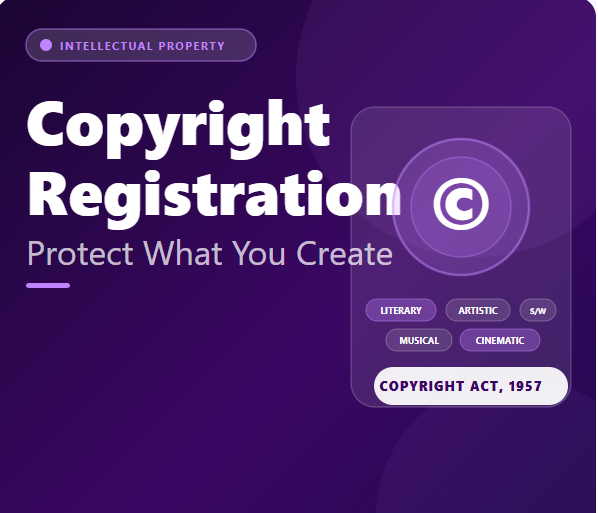
Copyright is a legal right granted to the creator of an original work — literary, artistic, musical, dramatic, cinematographic, or software — that gives them exclusive control over how that work is used, reproduced, distributed, or adapted. In India, copyright is governed by the Copyright Act, 1957 and the Copyright Rules, 2013.
Copyright protects the expression of an idea — not the idea itself. A business concept cannot be copyrighted. But the presentation, the design, the written content, the code, or the artwork that expresses that concept can be.
What Can Be Copyrighted
- Literary works — books, articles, blogs, scripts, training manuals, website content
- Artistic works — logos, illustrations, photographs, paintings, architectural drawings
- Musical works — compositions, lyrics, sound recordings
- Dramatic works — plays, screenplays, choreography
- Cinematographic films — movies, web series, short films, corporate videos
- Software / Computer programs — treated as literary works under the Copyright Act
Copyright vs. Trademark — The Key Difference
This is the most common confusion. Copyright protects creative work — a logo design, a song, a piece of writing. Trademark protects a brand identifier — a name, a logo, a tagline — as used in commerce.
The same logo can have both copyright protection (as an artistic work) and trademark protection (as a brand identifier). They serve different purposes and are registered under different laws.
Why Register If Copyright Exists Automatically
Copyright exists from the moment of creation — but registration gives you something that automatic copyright does not: a public record and a legal presumption.
A copyright registration certificate is admissible as evidence in court. It establishes the date of creation, the identity of the author, and the nature of the work — making it significantly easier to enforce your rights if someone infringes on your work. Without registration, proving ownership in a dispute is possible but much harder.
For businesses, copyright registration is especially important for logos, website content, software, and marketing materials — assets that are frequently copied.
Documents Required
- Application in Form XIV
- Copy of the work to be registered (soft copy / hard copy depending on the type)
- Proof of identity of the applicant (PAN / Aadhaar)
- If the applicant is a company or LLP — Certificate of Incorporation
- NOC from the author (if the applicant is not the author)
- Power of Attorney (if filed through a representative)
The Registration Process
Step 1 — File Application The application is filed online on the Copyright Office portal (copyright.gov.in) in Form XIV along with the prescribed fee. Fee varies based on the type of work — literary, artistic, musical, etc.
Step 2 — Diary Number Issued On filing, a diary number is issued immediately. This diary number itself serves as proof of the date of filing.
Step 3 — Mandatory Wait Period There is a mandatory 30-day waiting period during which objections can be raised by any third party who claims prior ownership of the work.
Step 4 — Examination If no objection is received, the Copyright Office examines the application. If an objection is raised, both parties are given a hearing.
Step 5 — Registration Certificate Issued On successful completion, the Copyright Office issues a Registration Certificate. The total process typically takes 2–6 months depending on objections and office workload.
Duration of Copyright Protection
| Type of Work | Duration |
|---|---|
| Literary, Dramatic, Musical, Artistic | Lifetime of author + 60 years |
| Cinematographic Films | 60 years from year of publication |
| Sound Recordings | 60 years from year of publication |
| Software | Lifetime of author + 60 years |
Relevant Sections
- Section 13 — Works in which copyright subsists
- Section 17 — First owner of copyright
- Section 45 — Registration of copyright
- Section 51 — When copyright is infringed
- Section 55 — Civil remedies for infringement
- Section 63 — Criminal offence for copyright infringement (imprisonment up to 3 years + fine)
The Practical Takeaway
If you have created something original — a logo, a website, software, a book, a film — register it. The process is entirely online, the fee is modest, and the protection it gives you in a dispute is significant. Waiting until someone copies your work to think about registration is always the wrong approach.